
Insights and News
Newsletter - Insights and News - LaCross Institute
Newsletter
SUMMER 2025 UPDATE
We are pleased to share our Summer 2025 update, the first ever from the UVA LaCross Institute for Ethical Artificial Intelligence in Business. It has been an honor to lead the institute in its inaugural year.
Since the launch in September, we have hosted an amazing conference, explored the research of several of our fellows, helped establish an exciting AI concentration for MBA students and published several research-grounded articles showcasing insights from our affiliated faculty. Highlights are below, and more news is available in the Insights & News section of this site.
As we approach our one-year anniversary, we look forward to continuing our work to accelerate the impact of the transformative gift from Dave and Kathy LaCross — and to realize the promise of ethical artificial intelligence in business.
Yael Grushka-Cockayne, Academic Co-Director
Marc Ruggiano, Director
Raj Venkatesan, Academic Co-Director
Meet the LaCross Leadership Team

Yael Grushka-Cockayne
Academic Co-Director

Marc Ruggiano
Director

Raj Venkatesan
Academic Co-Director
Launch of the Institute

In September 2024, the University of Virginia Darden School of Business announced the launch of the LaCross Institute for Ethical Artificial Intelligence in Business. The institute was made possible by a donation from UVA alumni David and Kathy LaCross (pictured above), whose generous gift is the largest in Darden's history. The institute builds on and expands the work of Darden’s AI Initiative and the Collaboratory for Applied Data Science in Business, launched in partnership with the UVA School of Data Science in 2021.
While housed at Darden, the LaCross Institute collaborates across schools at UVA and beyond, promoting an interdisciplinary approach to ethical AI research.
Darden’s dual strengths — developing responsible business leaders and advancing the theory and practice of business ethics — provide a strong foundation for a world-class institute focused on the promise and practice of ethical artificial intelligence in business. As AI reshapes how organizations operate and create value, the LaCross Institute will help prepare leaders to harness its potential responsibly — and for the greater good.
Key Insights from the Inaugural Conference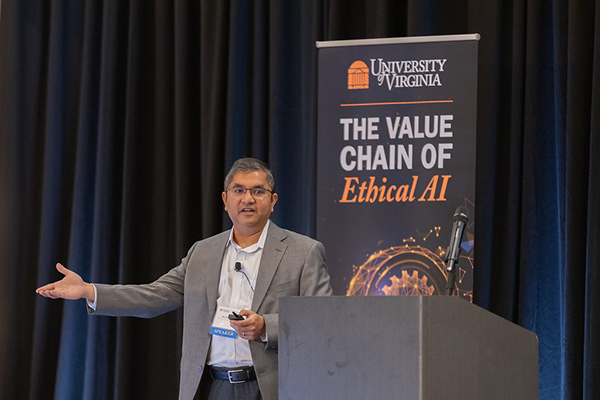
The LaCross Institute celebrated its launch with a signature event on 6 December 2024 at The Forum Hotel at Darden. The conference, titled "The Value Chain of Ethical AI," was a resounding success —drawing 150 attendees and nearly 30 speakers — and further established UVA’s and leadership in the global conversation on AI ethics.
As reflected in its title, the day's theme explored "The Value Chain of Ethical AI," a framework developed by the LaCross Institute to examine ethical considerations across AI’s lifecycle — from infrastructure and data management to model training, application and outcome monitoring.
The ambitious agenda blended academic insight and industry expertise through three keynote speeches and four rounds of concurrent sessions, including interactive breakout discussions. Keynote speakers Professors Raj Venkatesan, Tom Davenport and Kirsten Martin delivered compelling talks on AI capabilities, implementation and accountability.
Morning sessions highlighted research-driven perspectives from faculty across UVA, including the Darden School of Business, McIntire School of Commerce, School of Data Science, School of Engineering and Applied Science, Batten School of Leadership and Public Policy, and the College of Arts & Sciences. Topics ranged from the ethics of data privacy to the role of AI in autonomous systems and decarbonization.
Afternoon panels featured leaders from healthcare, technology and talent management, offering real-world views on the opportunities and risks of integrating AI in business. Speakers shared practical approaches to innovation grounded in transparency, collaboration and institutional accountability.
A distinctive element of the day was a series of interactive breakout sessions led by Darden faculty. Participants were invited to develop actionable ethical AI agendas tailored to their organizations, surfacing priorities across marketing, operations and finance.
LaCross Institute Academic Co-Director Yael Grushka-Cockayne closed the conference with a powerful recap, highlighting keytakeaways and reaffirming the institute’smission to bridge the gap between ethical theory and business practice in AI. A celebratory networking reception followed, giving attendees and speakers an opportunity to reflect on the insights shared and continue the conversation.
Highlights from the 2024 UVA Conference on Ethical AI in Business Ethical AI Conference are available in the archive section of the conference webpage.
The 2025 UVA Conference on Ethical AI in Business will take place on 5 December 2025. We hope you will join us then and continue conversations about the future of ethical AI in business.

New Concentration for MBA Students:
AI, Data Analytics and Decision Sciences
Launching in Fall 2025, UVA Darden’s newest concentration for its MBA program will equip students with practical skills and experience in areas of growing demand among employers — and rising interest among students. Darden has long been an early leader in coursework, case studies and applied research focused on analytics and artificial intelligence.
The School currently offers a range of analytics courses and joint degree programs with the UVA McIntire School of Commerce. The new concentration formalizes this curricular strength, offering students a selection of 25 courses, with at least six required to complete the pathway.
“This concentration is another indication of Darden’s commitment to educating responsible leaders who will understand and embrace ethical AI in their post-Darden careers,” said Yael Grushka-Cockayne, director of the AI concentration.
Fellowships in AI Research Awarded
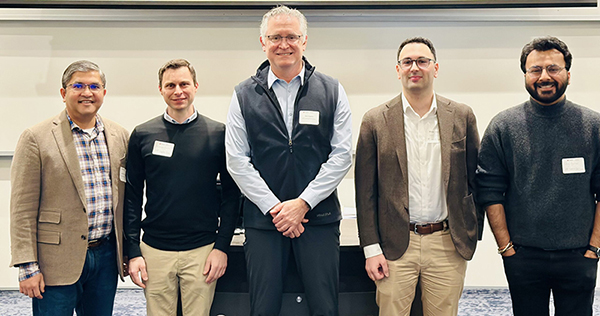
In February, the LaCross Institute announced the recipients of its 2025 Fellowships in AI Research (FAIR). The program is a cornerstone of the institute’s mission to foster interdisciplinary collaboration in ethical AI research — and this year’s awardees exemplify that collaborative spirit.
The first fellowship was awarded to UVA Assistant Professor of Computer Science Ferdinando “Nando” Fioretto, and Max Biggs, Assistant Professor of Business Administration for their proposal “Privacy and Fairness in AI Pipelines: From Data Collection to Decision-Making.”
The second fellowship was awarded to Samuel Levy, Assistant Professor of Business Administration, and Chirag Agarwal, Assistant Professor of Data Science at the UVA School of Data Science, for their proposal “Privacy-First Advertising and Machine Unlearning: Scaffolding Consumer Trust with Ethical AI.”
“The proposals indicate the significant amount of AI-related research activity at UVA, including in topics at the intersection of ethics and business,” said Marc Ruggiano, director of the LaCross AI Institute. “We recognize the effort, expertise and passion that were evident in all of the proposals. There were many deserving ones and we hope to see all of them progress in the near future.”
The institute received proposals from across six UVA schools — representing 10 disciplines and three universities — with many featuring collaboration among multiple researchers. All submissions aligned with the institute’s core focus areas: data privacy and ethical AI, human-AI performance, bias and misinformation, analytical leadership and healthy choices. Each proposed project included significant student involvement.
Thought Leadership
-
AI is Boosting Productivity: Why That Matters for Your Portfolio
Rodney Sullivan, executive director for the Mayo Center of Asset Management, explores how heavy investment in artificial intelligence is fueling U.S. productivity — and what that could mean for investors. With GDP and productivity on the rise, Sullivan outlines the potential for AI to deliver broad economic benefits: easing inflation, addressing skilled labor shortages, reducing production costs and slowing the growth of federal debt. These productivity gains may support continued market strength. However, Sullivan also cautions that macroeconomic headwinds — including Federal Reserve rate cuts, geopolitical tensions and China’s aggressive stimulus efforts — could temper progress.
-
AI-Generated Images Raise Age-Old Question: What Is Art?
Lauren Foster unpacks the creative and ethical questions surrounding AI-generated imagery. With insights from Assistant Professor Lillien Ellis, the article explores how tools like Midjourney and DALL·E 2 challenge long-held definitions of art and authorship. Ellis draws historical parallels to photography’s disruptive entrance into the art world and warns of over-reliance on generative tools, which may erode foundational creative skills. While AI can offer a productive “jumpstart,” its widespread use raises complex questions about ownership, authenticity and the future of human creativity.
-
Good Disruption Podcast: "AI Companions"
Darden professors Yael Grushka-Cockayne and Michael Lenox join sociology professor Allison Pugh to examine the rise of AI companions and their social implications. Pugh introduces the concept of “connective labor” — the human act of being seen and understood — and raises concerns about AI’s potential to displace human care and deepen inequity. The conversation considers AI’s usefulness in edge cases, like dementia care, but flags risks of overuse, especially among vulnerable populations. While AI may disrupt caregiving markets, Lenox argues that not all disruptions are for the better.
Rodney Sullivan, executive director for the Mayo Center of Asset Management, explores how heavy investment in artificial intelligence is fueling U.S. productivity — and what that could mean for investors. With GDP and productivity on the rise, Sullivan outlines the potential for AI to deliver broad economic benefits: easing inflation, addressing skilled labor shortages, reducing production costs and slowing the growth of federal debt. These productivity gains may support continued market strength. However, Sullivan also cautions that macroeconomic headwinds — including Federal Reserve rate cuts, geopolitical tensions and China’s aggressive stimulus efforts — could temper progress.
Lauren Foster unpacks the creative and ethical questions surrounding AI-generated imagery. With insights from Assistant Professor Lillien Ellis, the article explores how tools like Midjourney and DALL·E 2 challenge long-held definitions of art and authorship. Ellis draws historical parallels to photography’s disruptive entrance into the art world and warns of over-reliance on generative tools, which may erode foundational creative skills. While AI can offer a productive “jumpstart,” its widespread use raises complex questions about ownership, authenticity and the future of human creativity.
Darden professors Yael Grushka-Cockayne and Michael Lenox join sociology professor Allison Pugh to examine the rise of AI companions and their social implications. Pugh introduces the concept of “connective labor” — the human act of being seen and understood — and raises concerns about AI’s potential to displace human care and deepen inequity. The conversation considers AI’s usefulness in edge cases, like dementia care, but flags risks of overuse, especially among vulnerable populations. While AI may disrupt caregiving markets, Lenox argues that not all disruptions are for the better.
Save the Date

UVA Conference on Ethical AI in Business
Save the date for 5 December 2025 to join us for the UVA Conference on Ethical AI in Business at The Forum Hotel. Join our list to be notified when registration opens.

2026 Fellowships in AI Research (FAIR) Symposium
Save the date for 30 January 2026 to join us for the Fellowships in AI Research (FAIR) Research Symposium at The Forum Hotel and hear from current Fellows about their research and learn who will be joining the 2026 cohort.